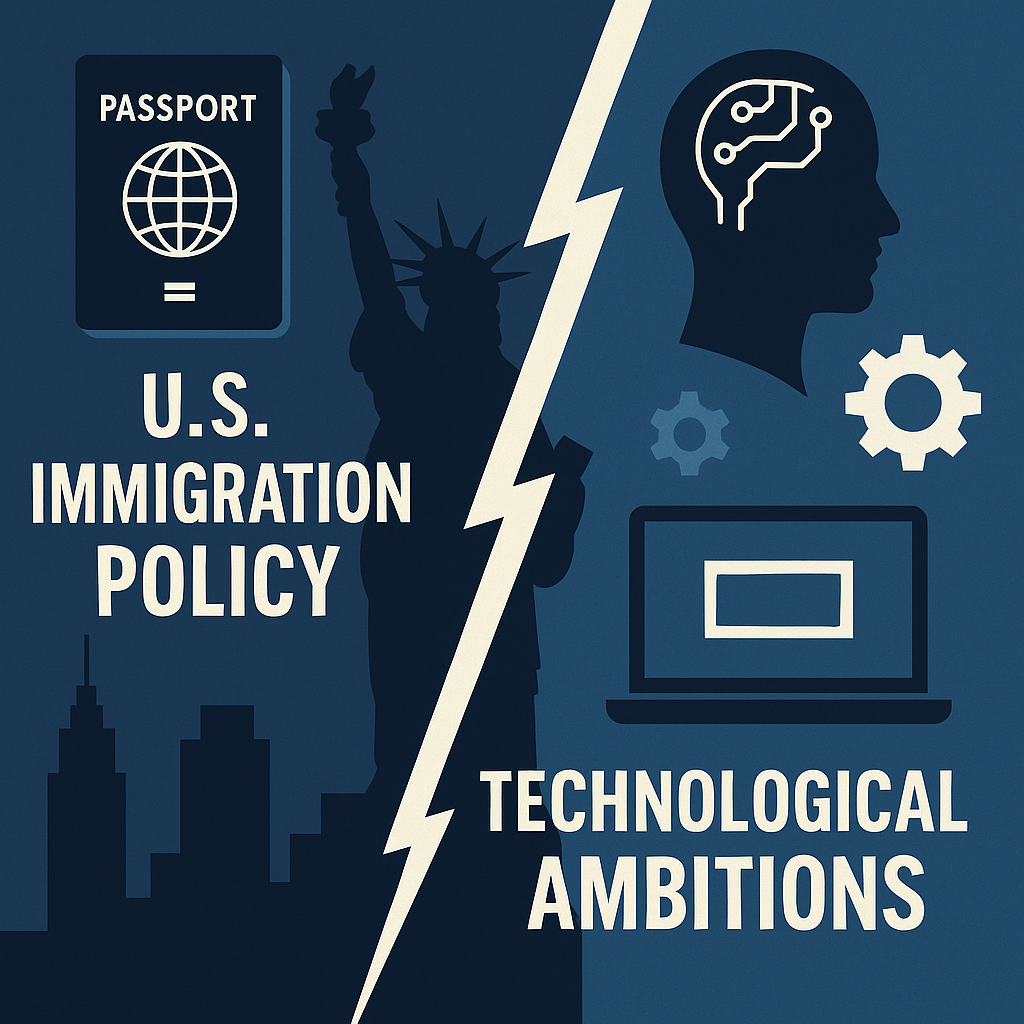
The United States has long recognized the value of attracting global talent to maintain its leadership in science, technology, and innovation. Yet, in practice, many of its immigration policies create barriers for the very professionals it claims to prioritize. This tension is particularly stark in the employment-based immigration system, where the goals articulated in the policy manual for EB-2 immigrant visa classifications often conflict with the restrictive realities facing highly skilled foreign nationals.
Policy Goals: A Call for Global Leadership
Under the EB-2 immigrant visa category, especially through the National Interest Waiver (NIW) provision, U.S. Citizenship and Immigration Services (USCIS) emphasizes that the United States has a vested interest in attracting individuals whose work will contribute substantially to “U.S. competitiveness and national security.” The USCIS Policy Manual states:
“In determining national importance, USCIS considers the potential prospective impact of the endeavor… endeavors related to research, science, technology, entrepreneurship, and other fields that advance U.S. competitiveness may rise to the level of national importance.”
— USCIS Policy Manual, Vol. 6, Part F, Chapter 5, Section D(2).
This reflects a broader legislative goal: the Immigration and Nationality Act authorizes waivers of the job offer and labor certification requirement for EB-2 applicants whose work will “benefit the national interest of the United States” (INA §203(b)(2)(B)).
These provisions were designed to attract scientists, engineers, entrepreneurs, and other professionals whose contributions could help the U.S. maintain its edge in emerging technologies such as artificial intelligence (AI), biotechnology, advanced manufacturing, and clean energy.
Policy in Practice: A System at Odds with Itself
Despite these lofty policy goals, the reality on the ground tells a very different story. In recent years, skilled immigrants have faced mounting obstacles in securing and maintaining legal status in the U.S.—even when they meet or exceed the criteria for employment-based immigration.
- H-1B Lottery: An Arbitrary Gatekeeper
One of the most widely used nonimmigrant pathways for high-skilled workers, the H-1B visa, has become notoriously unreliable. The annual cap on new H-1Bs (85,000 total, including the U.S. master’s cap) is far lower than demand, resulting in a lottery that leaves tens of thousands of qualified applicants and their U.S. employers empty-handed each year. The FY2026 cap has already been reached, with USCIS pausing new petitions months before the fiscal year even begins.
- Green Card Backlogs and Per-Country Limits
Even for those who successfully transition to permanent residence, the system remains deeply flawed. Applicants from high-demand countries, most notably India and China, face multi-decade wait times due to per-country visa caps. As of July 2025, EB-2 applicants from India are still facing backlogs dating to 2013.
This creates a paradox: a researcher who qualifies for a National Interest Waiver because their work is “essential to U.S. global competitiveness” may still wait over a decade to receive a green card—often at the cost of job mobility, family stability, and long-term career development.
- Chilling Effect on International Talent
These systemic problems are driving talent elsewhere. According to recent coverage, more international students and skilled professionals are choosing to pursue careers in countries like Canada, Australia, and Germany—nations that offer more predictable and welcoming immigration pathways [Times of India, 2025].
This is not a hypothetical threat. A 2025 Brookings Institution report warned that current immigration policies, if left uncorrected, could undermine the United States’ leadership in artificial intelligence by reducing access to global expertise. The report notes:
“Immigration has long been a critical component of American leadership in science and technology. Recent policy shifts… threaten to reverse this trend and push top talent to competitor nations.”
— Brookings, Trump’s Immigration Policies May Threaten American AI Leadership
Structural Contradictions: National Goals vs. Regulatory Obstacles
These developments highlight a deeper contradiction. On one hand, the U.S. is publicly committed to maintaining global leadership in emerging technologies. On the other, it maintains outdated and politically fraught immigration policies that drive away the very individuals needed to achieve that goal.
The result is a self-defeating feedback loop: policy language elevates innovation and national interest, while implementation frustrates it through bottlenecks, uncertainty, and systemic exclusion.
Path Forward: Aligning Policy with Practice
Several policy reforms could help resolve this contradiction and modernize the employment-based immigration system:
- Expand Dual Intent and Work Authorization
Allow international STEM graduates on F-1 visas to apply for permanent residence without jeopardizing their status, and ensure OPT/STEM OPT remain robust and predictable. - Modernize the EB-2 NIW Adjudication Framework
USCIS should issue updated policy guidance affirming that long visa backlogs should be considered a relevant factor in favor of self-petitioning via NIW. - Protect and Expand STEM Pathways
Prioritize employment-based green cards for STEM professionals working in critical fields identified by the Department of Commerce and National Science Foundation.
The Cost of Incoherence
At a time when technological innovation is central to economic growth and national security, U.S. immigration policy cannot afford to contradict itself. If the United States is serious about maintaining global leadership, it must align its legal frameworks with the strategic priorities it proclaims.
Highly skilled immigrants are not just contributors, they are catalysts. Keeping them out is not just a legal issue; it’s a competitive disadvantage.
Nothing in this blog should be construed as legal advice.